Monday, November 12, 2007

Escape from Colditz

My boyhood years were spent with my siblings in small rural town in Otago, New Zealand. More rural than town, our upbringing had a Huck Finn flavour about it in some respects. A well established and fond memory are the "contraptions" built by one of the brothers, the building of one being distilled in this (very) short story.


Escape from Colditz
A Story by PickledEel

Sunday, November 11, 2007

Walking Through the Roman City of Jerash

I took some photos and video when in Jordan recently. An earlier blog refers to that visit but the video gives a better feel for that place. I loved being able to walk through a place that gave such a sense of historicity yet connection with its inhabitants - all at the same time.

Thursday, November 08, 2007

Eating Squirrels in New Jersey

For those of who are not Americans, and/or who live outside of the CONUS there is a quip which explains the quirky, bizarre and just plain weird. It is simply "only in the US", usually said in a condescending tone, the combination of which helps the listener understand that there is a rational reason for the weirdness. Most commonly used when referring to the escapades of Hollywood. Here is one from the other coast that falls in that basket though. It goes something like this:

False alarm: New Jersey says it's once again safe to eat squirrels. Earlier warnings about excessive lead in the rodents that live near one of the Garden State's toxic waste sites was caused by a malfunctioning blender that they used to "process the squirrel's tissue samples," according to the federal government. Full article under this title:

Have no fear New Jerseyans, the toxic waste hasn't made it unsafe to eat squirrels after all

So what is the "only in the US" element hidden in this article? The squirrel element of course. Everyone else would be concerned about the toxins, real or imagined. Here the city council are pleased to announce squirrel is back on the menu!

Born in A Solomon Islands Dog Kennel

On our third day at Fauabu we had a look at the existing medical facilities. They are pretty primitive. The clinics to which the locals come, emerging from the jungle along invisible tracks, are extremely rudimentary. It is the post natal and post "op" care that we are building this ward for. And if we needed reminding of the need (we didn't really) this morning's visit got us focused. Here is the delivery room. Girls walk out of the bush, deliver their babies on this table and then recuperate on a veranda before walking back to their village. If there are a couple of deliveries happening at the same time then the spillover uses the floor. Perhaps what struck us most forcibly was the fact that this third world facility was operating only an hour or so flying time from first world hospitals and resources in Brisbane. But the lingering impression is the pride with which those who run the clinic showed us around. It is not much better than a dog kennel (one of the lads muttered he would not let his dog give birth in here) but it is all these trained nurses have got.

April 2003

Monday, November 05, 2007

Not so Sleepy Wellington - but Still Windy

I thought when I interviewed with Eric that my next overseas trip was going to be back into Asia but I ended up in New Zealand last week. In Wellington to be precise. Which is where the New Zealanders hide their politicians. In a building that the locals call the Beehive. It kind of looks like one of those upturned wicker type beehives , though nothing like the boxes we used to raid as kids - there were no bears in our woods doing that. It was the local ten year old boys, who would have copped a hiding if we had ever been caught. Wellington for me is always about memories of the Wahine disaster in 1968, also marked for being the year one of my sisters was born. Later I sailed into Wellington from Lyttleton and the bow of the Wahine was still protruding from the harbour waters. It has long gone but I still see it there in my minds eye. A buoy still marks the spot. Interestingly when I was there last week the winds that blew about town approached some of the speeds that lashed the harbour when that ship went down. Wellington has changed a lot since I was there in the early 1970s but it has a slow country town air which is pleasant. You can walk the length of the CBD very quickly but a slow stroll takes you through a quite cosmopolitan dining and drinking scene which is not what I have ever associated with this very windy place. I happened to be there in February actually and the businessman I was with for lunch bumped into two ex Army friends as we walked to lunch. Men he had not seen since his Army days. Its that sort of village.

The video here catches a more recent ferry heading for the harbour mouth, then the view out over Wellington (with the QE2 in port) and then some views of the Malborough Sounds as we headed back to Sydney.


Jews are Smarter than the Average Bear?!

Race is repository of IQ points apparently. According to a reporter sympathetic to the notion and who attended a symposium on the subject at the American Enterprise Institute. Certain Jews apparently demonstrate higher IQs than other demographics. Some Jewish communities apparently flash up an average of 107-115+ of those points when the global average is about 100. It would be interesting to know just how rigorous the testing was. I wonder from a slightly cynical standpoint – I swotted my IQ tests before I went through my officer training examinations. Not that I saw any test set by the military which I had seen in my rehearsals. But putting the brain to that sort of training and discipline, and having some practice at breaking down a problem presented in a particular way, meant I not only completed those timed tests you are not supposed to complete but easily packed 20 or 30 points onto the result. Some of my colleagues, who swotted their university exams like mad were horrified that I swotted my IQ exams – somehow that was not the same thing. I am not sure what their reasoning was but it seemed a reasonable approach in my book.

So Jews are allegedly smarter – if IQ points ever really mean anything. Their claims raise some interesting questions about race, Darwinian theory, comparative intelligence of Christians, the impact of historical events like the holocaust, and pogroms throughout history. Not to mention the matter of being a tight knit demographic which tends to marry and interact within its own bounds- thanks to that round of instruction from Mt Sinai, reinforced by lessons such as the Exile into Persia (Israelis are still trying to get back there lately I see!) Plenty of comments on the issue can be found at the Slate site. Based on my own experience of IQ tests and being able to load up a result I think the following probably apply:

Jews are great swots.

Those tightknit Jewish communities pass around volumes of previous IQ tests for others to swot up on.

Jews own and manage some of the greatest libraries in the world (just don’t tell the Vatican) and those old IQ tests are carefully catalogued, examined, distilled and methodologies are circulated to all Jews.

Schooling for your Bar Mitzvah is really a thorough grounding in IQ test papers.

Circumcision means you are less likely to cock up your IQ results (theory only applies to 50% or thereabouts of the population)

The Shin Bet and Mossad knock off any competitors before they can get to the examination room.

IQ tests are written by Jews.

And in the spirit of those supposed results I would hasten to add that there is no scientific basis to my theories. Which is a long winded way of me saying IQ metrics are bunk at best. But then I work with a Jew who has a brain as big as a house and who definitely is smarter than the average ah, person.

Saturday, November 03, 2007

Paul Tibbets and That Nuclear Bomb

Paul Tibbets made news again yesterday with the announcement of his death. (NYT Obituary) Paul was the pilot who flew the Enola Gay (named after his mother) from which the nuclear weapon was dropped on Hiroshima. The news of his death prodded surprising reactions from some in the the newspaper blogs I have been reading. I have the view, perhaps historically driven, that the decision to drop these two weapons was sensible when weighing up the costs of Operation Olympia, the planned invasion of the Japanese mainland. With more than one million casualties anticipated, the code breakers indicating the Japanese military factions had convinced the country to fight on and that the defences of the areas into which Olympia was to be directed had been reinforced, combined with Iwo Jima and Okinawa giving a foretaste of what a hometown fight was going to look like (pretty nasty), the two bombs made a lot of sense. But sixty or so years on and our revisionist perspectives prompt comments and views I don't entirely understand - some thought Tibbets' (apparently) painful death was a sign that he got what he deserved from God (just as well God is not a vindictive fellow isn't it?!). Others felt he was an officer simply doing his job (I am sympathetic to that view) while others felt he could have said "no" to the mission - clearly failing to understand the times in which Tibbets lived, or the structure in which he worked. All mixed up in other commentary that gets emotive after all this time about the rights or wrongs of various aspects of that war, aspects which have no connection with Tibbets in any way. Sadly Tibbets lived some of that ambivalence, emotion and hostility in his latter years and he has asked that he be buried with no tombstone least that be a site for protest. Whatever the rights or wrongs of that war it is a part of our history with threads that tie into the fabric of our community today. Beating up on Tibbets now, or at any other time for that matter, isn't going to change any of that.

Truck Trip to Fauabu (Foo arm boo)

We drove into the night from Auki along a track through the jungle with no lights. The sky was a heavy velvet blue drape that gave no sense of where we were or what time of the night it was. We forded creeks and crept past silent villages, thatch and lattice barely visible in the starlight. The cabs of the trucks were silent as we wondered at what we had gotten ourselves into. After the bustle of the the last few days getting everything loaded onto the ferry, this silent, reflective trip seemed very surreal. Nearly three hours later, after finally finding ourselves on a slightly better road we stopped in an open space at the steps of a white house that looked vaguely out of place in this dark jungle. White clapboard, tidy blue framed veranda and a tin roof. After the quiet trip we were all like boisterous kids as we found beds, moved food in and set up the mosquito nets. And discovered that it was now three o’clock in the morning.

I woke after the sun was well up. A couple of the lads were still snoring away but Mick was gone. I shuffled outside and saw him on the far side of the clearing talking to one of the local men, both beside a large tangled heap of timber. Turns out it was all chainsaw cut 4 x 2, intended for us to turn into the clinic building we were supposed to be working on.

The place is an old leprosy mission site, built in the 1920s but now gone to ruin. Some timber and stone buildings remain, and one clinic was rebuilt, but the main indication that things used to be different are the crumbling concrete slabs that mark where the leprosy mission buildings used to be. There is something sad and ghostlike about the place. But behind the house we discovered we are a short walk through the coconut trees to the beach, where we could see, to our amazement, dolphins playing in the water. We also found a crowd of boys who were very adept with their machetes, chopping palm wood into toys. In this case a small car, complete with wheels which turned. Even the axles were made from palm wood! Kids with swinging, whacking machetes though - this will be an interesting couple of weeks.

Sunday, October 28, 2007

Possums (12)

In 2005 David Paton, good friend, mentor, example, and inspiration died after experiencing an aggressive cancer. I flew to New Zealand to attend his funeral. On the flight back I started writing some notes that were intended to capture something of what David meant to me. Taking a deep breath I thought I would share them more widely here on this blog. They are less coherent than I would like but they tell a story of what a difference one life, honestly lived, can make to those around them. These notes are offered up in 15 chapters which I will post out over the next few weeks. And in order that you can put a face to a name, here he is, on the Stewart Island ferry, catching some "zeds". Or "zees" depending on what part of the world you hail from.

The pet possum was a rare animal, treated with compassion and given a citizenship in the house that few other animals ever had. Ordinarily the Australian brush possum is hunted without respite, it being a noxious pest in New Zealand, causing millions of dollars of damage to forestry and agricultural resources every year. They are hunted with a passion and were the source of some pocket money as we grew up. Out on the Run, with the dogs loose it only required a whispered “sic ‘em” to have a pack of half a dozen dogs or so (sometimes more) to get their blood up and to tear off towards the nearest outcrop of rock to hunt out a possum. Whether there was one resident there or not. David would amble along behind to see what would flush out but often he was the one grabbing this or that dog and force feeding it down a hole or crevice. Sometimes a possum would flush or sometimes a possum would deter the dog with a well aimed swipe at the nose. Sometimes there was only a lot of noise, dust, and slow grins and absolutely no possum to show for the hunt. One possum escapade was especially memorable. It was at Waihola. On that place there was a very old woolshed. At one end there was a lean-too structure which was only a single story high, with a corrugated roof. Somehow we had learned there was a possum resident in the roof but we were unable to flush it out. With a ceiling pinned to the reverse side of the rafters there were plenty of places for it to hide and no way for us to see in. David’s solution was to pick up one of his scrawniest dogs (he used to bring a selection of them down to Waihola, and in the days prior to the purchase of the truck they would all be piled into that old Ford) and stuff it under a loose bit of corrugated iron on which he would then stand to prevent the dog reversing out. Hardly any need since every dog knew that a hunt was on with the cue “sic ‘em” and the place stank of the possum in any event. There was a huge commotion from within the roof as the dog scrambled around in the dark, barking and yelping and the possum growled and shrieked. I have no idea how the possum got out but remember being surprised at its appearance as a dark blur evacuating from under the guttering, flying across the yard and scrambling up the trunk of a huge old macrocarpa tree nearby. Its second mistake was to pause to look around and get its bearings. David shot it dead. We then spent some effort in extracting the dog from under the iron and I recall a few sheets having to be lifted. That old woolshed came down a few years later and was replaced by a new structure that did not leak but had none of the adventure in it that its collapsing possum ridden predecessor had.

Standing on the high country of the Run on a snowy day I paused with David and watched the “bread bus” making its way along the pigroot. David had stopped striding across the tussock to point out that the bus was travelling way too fast on a road covered with ice (he would know) and only opened that morning by the council grader. He suggested we watch it disappear around a bend on the side of the distance spur, across the gully and in the far distance and see if it reappeared on the road further down the valley. “My bet” said David, “is that we don’t see it reappear.” And we didn’t. An hour later we edged our way carefully back up that same bend and found the bus on its side in the snow. The driver seemed very nonplussed and was sitting in the snow drinking from a thermos flask and making wise cracks about the mail not getting through. But as we chatted we realised he was very shaken – as he had swung around the bend only seconds after vanishing from our view he had lost control and was heading for a dramatic drop into the creek below. Somehow he had wrested his careening vehicle to the other side of the road where he had deliberately aimed for the ditch in an effort to get the thing to stop. We left him in the snow and ice, in the rapidly dropping ice blue shadow of the end of the day and said we would call the council to see if he could get him towed out. An hour later the grader came through and about an hour later the bus crept past David’s house, somewhat chastened no doubt.

We left the Run late one night in pouring rain. We had been up there at midnight in late spring, shooting rabbits using a spotlight. The booming .303 was something of an overkill, deafening those in the cabin and proving to be more of a fun factor than anything else. I can still hear Steve saying “Bruce, put that thing away!” as the muzzle flash lit up the night and the thunder of the shot cracked across the gullies. The rain increased to a point where, even if there was a rabbit out there we would be hard pressed to see it so we departed the top of the Run and headed down to the highway. Travelling back to David’s place, as we drove up a long gentle slope in the highway a rabbit hopped out onto the road just at the edge of the headlights. Not in any hurry but just edging along in a slow lope. David asked me to pass over the .303 which I did. Leaning out the driver’s window he proceeded to blast ten rounds up the highway. One hand still on the wheel. Chunks of Highway 75 were flung into the night but the rabbit continued its slow lope, seemingly oblivious to the noise behind it and the destruction around it. In the end it hopped into the verge and stopped after which we duly dispatched it from a distance of only inches. The “one shot, one horse” legend was in tatters!

But not so much that I ever failed to appreciate his praise for my shooting. Getting a pat on the back from David was rare but when it came it was very special. Once at Waihola he took about five or six of us kids up to what was then known as the CYC paddock, the only patch of green grass on the place. From a high vantage point we looked down onto a large puddle on which was floating a thin stick, about half an inch thick and barely visible. About 75 yards away he said. Giving us all one round he then handed his rifle to one of the group and asked us to hit the stick. One after another twig was bounced around in the water until I was handed the rifle. Taking quick aim and dropping the sights on it I fired the round and the twig became two. David was impressed. I savoured that praise for years.

Previous Post

Sydney Turns it On

It must be Sunday - time to get back into the Blog! There is always a temptation to go searching for inspiration outside this town but the fact of the matter is there is enough material in this town to inspire and convict - you don't always see what is right under your nose. A small thing that always captures my imagination happens every year and is a case of the "bleedin' obvious" in terms of things that make you slow down and put things in perspective a little - the suburb grow a purple mantle and a slow rain of purple litter covers the footpaths, the garden shed and our backyards as the bare branches of the Jacaranda announce the end of the winter months (we don't really have a winter of course). The Jacaranda does that with a vengeance. And if that does not catch our eye the Bougainvillea is at its blushing and fiery, flamboyant best. On the odd occasion a mix of Jacaranda and Bougainvillea happens in the same space and the blend of colours is enough to have you want to stop the drive to work and simply soak it all up. To top it all off the harbingers of these spring explosions are the amazing magnolias, some which remain in bloom if it has been cool enough - though not this year. Nothing profound in any of this, simply an acknowledgment that we are blessed to live where we do for a whole range of reasons. One reason is our environment.

Bloggers Choice Awards


Many of you kindly voted for the Pickled Eel by clicking on the icon to the right. The 2008 Bloggers Choice Awards are now running so the counter has been reset. If you have a few spare moments I would be very grateful for a vote out there. Its not a bad way to get the blog exposed. Thanks.
p.s. the page is currently parked on the second page under Best Travel Blog.

National Thong Day

Where I grew up thongs were known as jandals. Who knows where that word ever came from - short for Japanese sandal apparently! Australians call them thongs while in the US they are flip flops. American thongs of course are much more attractive - though that always depends on who is wearing them. Same rule can apply to footwear I guess.

Somehow this slipped past me but National Thong Day, held last Wednesday, 24 October, apparently was aimed at drawing attention to poverty issues. Which can only be a good thing. We need constant reminding that there are others out there who need help. And those are not always overseas but most often are to be found right under our noses.


Having said that there is a small group here who round up resources from the corporate world and who package them up into gift packages and send them off to Sri Lanka each year. I have drawn attention to it before but in case you missed it, or perhaps want to be inspired by how one person can make a difference in the lives of others - in this case mainly orphaned kids - then have a look at Network Heaven.

Sunday, October 21, 2007

In Defence of Private Contactors

Like most I was appalled by the videos on YouTube showing the cavalier actions by Blackwater contractors engaging "targets" without any apparent rules of engagement which might have gone some way to determining if the vehicles bearing down on them on the highway were in fact a threat or not. I am not sure if there are any documented instances of there being a clearly identified threat - citizens in a hurry to make a doctors appointment or in some similar innocent scenario are gunned down from unmarked cars if they have the misfortune to say, try and overtake an unmarked Blackwater vehicle. I was in Baghdad when the Blackwater teams hammered 17 citizens when they thought they were coming under fire. I am the first to appreciate how that impression can come about but for Blackwater this was only one of many incidents and the Iraqi's have clearly had enough. I read today in the Washington Post that the FBI is having a hard look at the incident while the US DoD and State slug it out over the merits or otherwise of using companies like Blackwater.

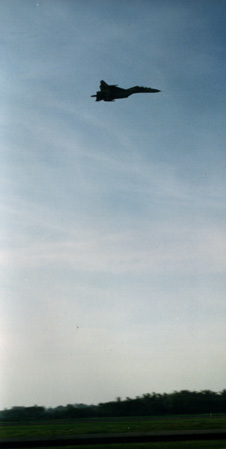
Fortunately the sunglassed, bandanna wearing Blackwater cowboys (the cowboy sobriquet also applies to those who fly these helicopters shown here) are not the whole story. I spent my time with a contracting company which provided not only security services but is intimately involved in the reconstruction efforts in Iraq. Their company operations are predominantly staffed by Iraqi nationals, they live and operate outside the International Zone, are committed to a genuine "hearts and minds" effort with all they deal with and are as integrated into the local scene as they can possibly be. I watched them deal with Iraq civil servants and was intrigued to see how they engaged and interacted with them, treated them as they would like to be treated themselves, were deferential and respectful. It is a far cry from the shoot first, ask questions later which damns Blackwater and their ilk.

Use the contractors by all means (they allow the troops to focus on what the troops need to do) but the Iraq government could do worse than filter out those who have an interest in their contract dollars over and above their interests in the rebuilding of this community. Those security contractors who have a philanthropic and compassionate agenda within their business goals do exist. (And no, I am not employed by one, just in case you thought this was a self serving plug).

Saturday, October 20, 2007

Bomb Harvest

Imagine there was a new Unabomber at work in the US, sending letter bombs out across the nation. Now imagine there was one in every state, so that 164 letter bombs went off in one year, killing 36 people, 15 of whom were children. Would that make headlines?

So commences a review by Paul Byrne of "Bomb Harvest" in the Sydney Morning Herald. An Australian documentary which follows the work of an Australian called Laith Stevens. Paul's review is simply titled Bomb Harvest and can be read by following the link. There is a handy trailer which gives you an idea of what the movie is about.

I went along to the Roseville Cinema tonight to have a look. Regrettably there were only three in the theatre. But we got a clear message about the danger of unexploded ordnance, and the way the filmmaker has you on the edge of your seat as cute little kids unearth bombs is worth the effort to catch this documentary if you can. It did not enrage me (there are some images that might be confronting) as Byrne warned it might, but the message that came though most clearly for me was the capacity we all have to make a difference, even if we are only one person. Laith Stevens is doing that with his life, and what he does has a direct and immediate benefit for some of the world's poorest people. It is inspiring stuff. Sadly it makes too few headlines Paul.

Midnight at Auki

We arrived late into the port of Auki. The ferry slowed and the stern got caught in its own wake, lifted it up and tipping us forward in a slow motion pitch. Initially we could see nothing but eventually a row of lights on the dark water or hanging in the sky (each was not able to be discriminated between) pointed in the general direction. A vague hint of island on the horizon proved to be imagination only – it was simply too dark to see anything. When we finally docked it was midnight and the tide was low – the ramp up to the end of the jetty was a steep climb.

Auki was a revelation. Hot. Dusty. Dark. Shadows flitted under lamps and the laughter of relaxed and drunk people jolted out of the dark. We could hear them but not see them. The lights illuminating the streets were low wattage and few and far between and initially we were hesitant to walk up what looked like a wild west movie set. But eventually thirst drove us into town and we found a shop up a back lane open. Despite the hour – it was now after midnight. He and his numerous assistants were serving warm drinks but with nothing on the shelves to advertise whether he was a hardware store or a food store. We bought our softdinks and some for the others and wandered back through this strange ghost town to the wharf. A melee still kept us from unloading our gear but eventually the crowd cleared enough for us to get our truck out. And another one in to pick up the extra hospital beds. None of the locals were in a rush. And clearly the arrival of the ferry was a big deal, the cause of much laughter, lots of greetings and some singing. But what a strange town Auki is at this time of the night. Ghost town. Wild West set. A strange orange, hazy glow hung around the itinerant street lamps but most of the place is in darkness, the deep velvet outside the main street only broken here and there by the soft, weak glow of a turned down wick of a kerosene lamp. And each of those signals a crowd sitting around laughing and talking. Smoking and drinking.

April 2003


Friday, October 19, 2007

The Sanatorium

John "the Global Bedouin" has pointed me at Writer's Cafe and otherwise encouraged me to get some of my writing up there. I have been dusting off some short stories to that end but thought I would start with recollections of my first attempt at a short story. The original is lost but the imagery contained in it and the setting has stayed with me for more than thirty years. It is posted at the link below.
The Sanatorium
A Story by PickledEel

Monday, October 15, 2007

Tale of Two Beaches

He was wearing a small trenchcoat and looked a bit like a pint sized Robert Redford, with a clichéd shock of blond hair and an open and engaging impish face.But his shoes! His shoes were black, patent-leather-shiny treads with sharply pointed toes and impossibly long. At least a half size again and rising slightly at the bow like those pixie shoes we all imagine those creatures wear. He was with two friends and they flagged down the Drug Arm bus. We stopped and chatted for a while. They were sober and were simply walking around this beach village because they had nothing to do. They were smartly dressed, fashionably so. His impish grin and self confidence was engaging and we found ourselves talking about school plans (for exclusive private schools), parents and politics. He was in Year 9 and his two friends in Year 12. Articulate. Informed. Aware. Opinionated. Self assured and self contained. Headed home with friends to watch DVDs.

He had a number one haircut and a blue-yellow bruised cheek. Two beaches south. Hailed us as well but for another reason. Curt. Aggressive but not offensive. Lived with his mum in a one room flat. Dad in a one room flat on the other side of the city. Down from the country, thin, hunched against the cold - he was made of high tensile fencing wire. Sharp. Glittering eyes. In our faces, f**king this and f**king that. Mainly cursing “f**king gronks” who had gotten two 14 year olds drunk, stolen their handbags and phones and left them on the beach at midnight when it was snowing in the mountains (i.e. it was cold out).He did not know the girls but had stumbled over them when he came down to the beach with his friend for a smoke. He called an ambulance which arrived, handed out a couple of blankets and left telling him they were in no danger. He was furious at that. All of fifteen or sixteen this firebrand Samaritan, and his moral outrage, with nothing to offer except his compassion, had no intention of leaving the girls on their own least some arrive and molest them. Stomping about in his tight T-shirt angry at the world, at the girls, gronks, his mum, ambulance wankers, himself. And us – we had to leave as well

Wednesday, October 10, 2007

Pickled Eel Interviewed

Eric over at Travel Blogs asked me a few questions recently - they are listed below. He posted my replies up on his quality Travel Blog site which he has managed to built into a rather good travel blog in a short period of time.

The questions were:

Pickled eel... Is that a delicacy you'd recommend?

You seem to travel quite extensively for work. Do you think this kind of business-related travel is an enjoyable way to travel? Or does the "work" factor diminish the enjoyment somewhat?

Since you spend so much time on the road for work, what does a holiday look like for you? Does it still involve travel, or do you prefer to stick closer to home?

You have been to places like Iraq and Jordan, which many people would consider too dangerous to travel around. Have you ever said no to travelling somewhere because you considered it too dangerous?

Do you think the risk-factor actually adds to the appeal of travelling to dangerous places?

Once this business trip to the Middle East is over, what's next? Any big trips on the horizon?


The responses are at Travel Blog - but take the time to have a look around the rest of his site. There are some interesting characters there traveling some interesting trails.

Tuesday, October 09, 2007

Post Iraq Muse - An Introspective

The muse have fled, or so it would seem. Best I have been able to do these last ten days is drag out an old journal entry from the Solomons! I drove from the airport directly to work and had half a day at the desk before I headed home before I fell asleep in the office. And as I did so, through newly sprung maples and watching sulphur crested cockatoos playing in the wires near home I thought how safe and boring it all was. I thought I would still have insights and things to say about the place but by the time I resurfaced a week later from Board meetings and other distractions I discovered the stimulation of the place had been fuel to my muse and now I regret constraining myself to an entry a day. If that environment was stimulating to the muse then this environment is enervating, something I had not really appreciated before. Sure, the alertness and "liveness" I felt in Baghdad revisited previous jobs in edgy places that I have enjoyed in the past. But I had not appreciated the impact the environment has on my creativity or on the desire to pry into what makes things and people tick. I could talk about the sound of news choppers here and all that is trite and mundane when those sort of comparative exercises are worked through but I suspect they would be seen for the contrived efforts they could only be. Perhaps rather a note here that I have some images seared into my mind as the visit recedes into history. The face of a driver of an old Datsun as we passed him on the road out of Baghdad - eyes reflecting the shrieking silent fear of being out there on his own (while I took some consolation in my protective armour and team). A solitary middle aged figure standing in front of his empty shop, gazing at us as we swooshed past. The faces and poses of men standing outside their cars with their hands up - just in case. Indolent soldiers on the street behind their anti aircraft cannons. Three men standing by the Tigris with nothing to do. Watching us closely and our own security people getting edgy under the idle scrutiny. Old women chatting in front of blasted shops, as if there was no war happening at all. A woman and her small daughter pulling along the sidewalk as fast as they could go, not looking around for anyone or anything. Other children going to school as if this was a normal street - they and that attitude will be the salvation of Iraq. Rows and rows of blank faces waiting outside the ministry, with no work, no place to go, no home to return to with any dignity. Best to look like you have been at work all day. Smoke on the horizon marking someones ruination. Silent shadows appearing over the Tigris and settling into their nest on the banks of the Tigris, choppers of all types silently returning from whatever they had been up to. Faces. Faces. And more faces. I need to get back there. Soon.

Wednesday, October 03, 2007

On Ironbottom in a Flatbottom

The ferry for Malaita was supposed to get away early in the afternoon. But as with anything in the Pacific Islands no one really knew the timetable. We were supposed to do this on Tuesday. Now it is Thursday. Be gone at midday. Get going after dinner. Symptomatic of all this madness is the fact that there is no captain on the bridge. Rather, it is crowded by dozens of people, none of whom look like they should be there. The ramp to the ferry, Ramos, dropped onto the dock at Honiara (which sits on the island of Guadalcanal, famous for the fighting against the Japanese which took place here in WW2) mid afternoon even though the ferry was tied up alongside for a good few hours before hand. Before arriving at the ramp it was tied up at a larger jetty and for that period we took the opportunity to load the hospital beds – manhandled across the rails, down some stairs and into the cargo bay. Departure was hilarious. It was finally dark. Families were squatting all around the vehicle ramp of the ferry. As the ramp finally came up the mad scramble was not from those onshore making a hurried entry but those family seeing off other family who had to vacate very quickly. Some of us are camped on our truck with all its equipment and material just in case someone wants to help themselves. But most people seemed fixed on settling down for the night and getting some rest. We hoped for the same but the heat is ovenlike, the humidity oppressive. The lights are dimmed and the deck here, from bow to stern is thick with huddled groups drinking, playing cards, arguing, singing and chewing betel nut. Even though they are not supposed to. It is all a little incongruous since the ferry, ex Hong Kong, is all still signposted and marked up in Chinese characters. No one seems to care. We slide out on a glassy sea and beat our way across the eastern fringe of Iron Bottom Sound, site of huge Japanese and allied shipping losses during WW2. That the ferry is flatbottomed means nothing until lightning and thunder rip open the night and suddenly everyone is awake and hanging on for dear life. Hot rain lashed us for half an hour and we endured it all in silence. And with not a little concern as we were flung about. Those on top of the truck scrambled down for a less precarious ride. Then just as dramatically it was all over and we were returned to a mirror sea and the flying fish that sailed along in flashes of reflected light beside us. For which I was thankful since in the crash of the storm I offloaded dinner over the side. I normally travel better than that. Hours later the dim, dusky orange light on the horizon, looking like something suited to “Heart of Darkness” marked the slow approach into Auki, on the island of Malaita. Malaita will be home for the next ten days or so but we have a long drive ahead of us after we reach Auki.


April 2003

Wednesday, September 26, 2007

I am the Captain of the Taxi - To the Tune of Amazing Grace

There are moments in life that are just laugh out loud crazy. And in this case slightly alarming. The high speed run from Amman to Queen Alia Airport this afternoon was with a very pleasant and energetic driver who told me he was ten years in the Jordanian Army, retiring as a Captain and for the last ten years he has been Captain of the Taxi. All worked out through broken English and he producing photos of his Army time while we wandered from lane to lane at 120km/h in an old Nissan that was having problems with its transmission at that speed. Both hands off the wheel. Sometimes when conversations falter these drivers put music on. Usually Arabic or sultry Lebanese. But in this case, in mid conversation he popped a tape on and shouted with glee – “back in the Army, scotch (sic) teacher”. At which point martial pipes and drums music blared forth and killed our conversation dead. Now he was just a dangerous driver as he conducted with his right hand and kept time by slapping his knee with his left, occasionally shouting “parade ground” interspersed by a droning hum or a tuneless whistle. As we neared our destination, after marching all over the parade ground in his mind for thirty minutes, the swirl of Amazing Grace came on. He slowed up to tell me how Queen Nor used to love Amazing Grace played by the bagpipes and that once she asked him to make sure it was played at a certain ceremony. The details were lost on me. I told him it was a song about how amazing God’s love is to his people even when we misbehave. He shouted “yes”, turned up the volume and struck his imaginary baton in the air as he hit the gas again. In the end it was only a Hummer at a checkpoint that momentarily quelled the pipes, but as we swung into the terminal Mull of Kintyre was winding up. As he left me kerbside I could hear it blasting from his cab, barely drowning out his tuneless whistle. And his baton was still waving. I hope he got back in one piece.

Taxi Story - The Jordanian

(In Jordan. To and from Jerash). Hello, my name is Ishmael. You want to go to Jerash? At this time of the day? OK, no problem, no problem. You want to visit craft store for souvenirs? You have enough souvenirs. OK. No problem. Did you know Ismael was related to Ibrahim in the Bible? It is an ancient name. I live just outside Amman. Look at all this countryside. In 1967 all these market gardens and this little valley was home to a million Palestinians displaced by the war. You want to look at that castle? OK, we are going to Jerash. No problem. Here (in Jerash) are all sorts of things to look at and I will show you where to start and will wait until you finish looking. Please don’t hurry. I am happy to wait. Did you enjoy that? It is a special place isn’t it? I brought my wife up here two months ago just to remind ourselves how special it is. When you live here you can forget. I have nine children. I am very lucky to have all good children. And very lucky that they can all do the things they want without worrying about their future or living like those Palestinians had to in 1967. The peace with Israel was the best thing that has happened to our country. My two eldest daughters have been in university. One studied biology and is now getting a job. The other is in her first year at university. All my other children are in school. The youngest is twelve. Two of my children were twins. Two of my daughters are married and each has two girls. (Laughing) I am a grandfather. It is a good thing and I like it very much. Do you mind if we pull over and buy fruit? Thankyou. Here, you will like these figs I have bought for you. It is Ramadan and I cannot eat until sundown but please, have these figs. Let me wash them first with this bottled water. And please, take this rhumahn (phon: = pomegranate). My wife will be happy with these eggplants and fruit, because all the family get together at Ramadan and they eat a lot. It is cheaper to buy fruit and vegetables on the side of the road than to buy in Amman. Thankyou for your talking. I have two nieces in Wollongong. One day I will visit Australia too.

Monday, September 24, 2007

Jerash - Roman City

Since the time I was a kid I wanted to walk around Roman ruins. There was something magical about all those columns. It was a desire fuelled even more when, for a year at high school, we studied Roman art and architecture and columns and plinths, capitals and inscriptions in detail. A year of Ancient (Roman and Greek) history at university kept the interest alive. And in their own quaint way the pictures of Asterisk and Obelisk continued to pique the fascination. Fortuitously I arrived back on a day with all the offices shut and a few hours of sunlight left. I grabbed a taxi driver (so to speak) and directed him to Jerash. No side trips to souvenir shops run by a distant cousin. To Jerash only. No, it’s not too late in the day. Heaps of time. Less talking more driving.


Jerash is a well preserved and partially restored Roman city on the outskirts of Amman. I happily wandered its streets for hours (and the driver seemed content to wait which was very decent of him). Here are the wide colonnaded streets, pavement still cut by chariot and wagon wheels. Here too the little lanes into roofless houses in high density apartment dwelling we would be very comfortable with. Cellars. Temples. Fountains. A hippodrome. Two amphitheatres still in working order and used for performances today. Shopping centres. Churches. An earthquake in 790 AD pretty much ended this city – all those blocks of stone resting on columns must suddenly have looked like a liability when the earth started moving.

But there are other durable pieces of stone work that can only be admired for their creativity and ingenuity. With some of the buildings stripped down you could see how they hung ceilings and floors two or three stories high – with a lot of cantilevering. There is a remarkable dedication in stone to the nymphs, a collection of fountains placed in a wall, fed by water down two kilometres of piping. The piping has gone, the fountains remain. Even the way the stone was dressed was mimicked in Victorian stone masonry 1500 or more years later and you can see the same style of work in London, Sydney, Philadelphia (which incidentally used to be the name by which Amman went by). Those cut pavers, the apartments with their cellars and an old well hint at real people walking around this place. They have an eerie presence still. Most poignant were the fallen stone decorations, on which you can still see the chisel marks of the masons. Nearly 2000 years dead yet his handiwork is still visible. As I was caught by the sight of it lying in the dust of centuries I thought of our yearning for immortality – a universal desire across all time to be able to spend all time crafting what we can do best. How disappointed that mason would be to see his work thrown down like this. Or would he be happy to know we are thinking of him? Happier still no doubt if he was still plying his craft.

970,000 American Casualties. Is Iraq Worth It?

Naturally even departing Baghdad is extraordinary. How many international airports require you to pull over on the approach road, empty your magazines and then dry-fire your weapons to demonstrate nothing is “live”? No others spring to mind. Then drop your bags on the road outside, in a large concrete revetment while a bomb dog crawls over your gear. Then imagine a third world mess inside - at least in terms of organisation and graft. 8kg underweight (baggage that is) and I am still up for USD25 for excess baggage. But if you want out of here…! I happily paid up. All of that will sort itself out in the end. I am normally a very patient traveller but by the time I got to Jordan and endured my ninth bag check I was feeling very irascible. Even after being dropped off at the aircraft in the Baghdad heat there was a pat down and bag check. You do what you have to do.

To answer the question, the short answer is yes. Not only from a personal business point of view but also from a broader perspective as well. This place is on the mend but there is no denying it has a way to go. And it is on the mend because local Iraqis are resolved to mend it. Be they the occasional and too infrequently met local, the public servants or the young diplomat I met in the queue waiting to check in this morning. He and a few others were off to Rome to do a course. He has high hopes for Iraq and his belief in what was possible was heart warming and encouraging. People like this make the effort worthwhile I think. Interestingly we discussed the convulsions that have been at the root of the building of other nations. Starting with the US – which is “united” at the cost of more than 970,000 of its citizens dead and wounded. Can you imagine that body-count being reported in today’s press? About the same number of Americans killed by each other as perished in WWII. (And as a footnote is it not interesting that the US had a 12 year Reconstruction period after its civil war? We all want Iraqis to sort themselves out in a couple of years!). Japan. France. Even present day Russia. Vietnam. India. South Africa. The Balkan states. If we could forge nations in other ways we could and should. But sometimes it happens in the worst way. We parted with a handshake (when I was called to a spare seat on an earlier flight (not everything that happens in Baghdad is bad!!)) and a controversial observation – he cocked one of his eyebrows at me and wryly noted that none of their Arab brothers were coming to their aid – it was all the Christian states who were helping, and he said Iraq would always remember its friends. This young man has an interesting diplomatic career in front of him to say the least. But it is that freedom of expression that comes with all other freedoms that we all want to see in Iraq. He said something he would not have dared utter five years ago. Now he feels free to voice his views to a stranger. If we can achieve that, without him eventually becoming a casualty for his forwardness, then Iraq’s people are worth it.

Sunday, September 23, 2007

Baghdad Rooftop Reflection - with some help from the Frogs

At about 11pm a half moon hangs in the sky. I’m sitting on a flat roof reclining in a dusty poolside recliner (though there is no pool), in a hot breeze. Just listening and watching. It is still but not quiet. This city does not sleep. But it is a softer city in this dusky light. Frogs among the eucalypts rhythm their quiet and indolent blues. Distant mosques broadcast their calls and prayers in a melodic tone that is beguiling, a soft chorus that hints at more civil and ordered things. Of better things. The normal city background rumble of traffic adds its background hum. Flares drift down through the trees. Silent, and betraying an unheard and unseen helicopter. Occasionally the drone of piston engines carefully buzzing their surveillance, also unseen. Drifting in and out of the peaceful stillness. Which is broken every now and then by Pumas or Blackhawks thundering in pairs over the house, roaring in then fading out swiftly. Leaving us again to the mullahs and the frogs. A civil airliner flashes its strobes as it lazes its line north, unlike the unseen military jets that occasionally bore through the sky. In and out much more quickly. I am out of here tomorrow and I find myself up here in a reflective mood. There is nothing like being here, if only briefly, to appreciate just how critical the momentum needs to be maintained in getting this place on its feet. It can be done, and it is a work well underway. There are moments when you worry about the place, as we did this afternoon when four or five “booms” carried to us on the wind. Initially we thought they were artillery but eventually decided they were bombs. Unlike hearing them in the news, these carry a clear personal message – that someone has been hurt, and for no reason. Somehow those blasts now seem a lifetime ago as I sit up here under the moonlight and soak up the evening. The frogs are now the constant background theme, far better than the murderous noises heard earlier and throughout this visit. I am hopeful that with some perseverance Malik and others like him will soon be able to relax and get back to their rooftops in the evening, the “booms” being only a bad memory from a distant era. I certainly pray so.